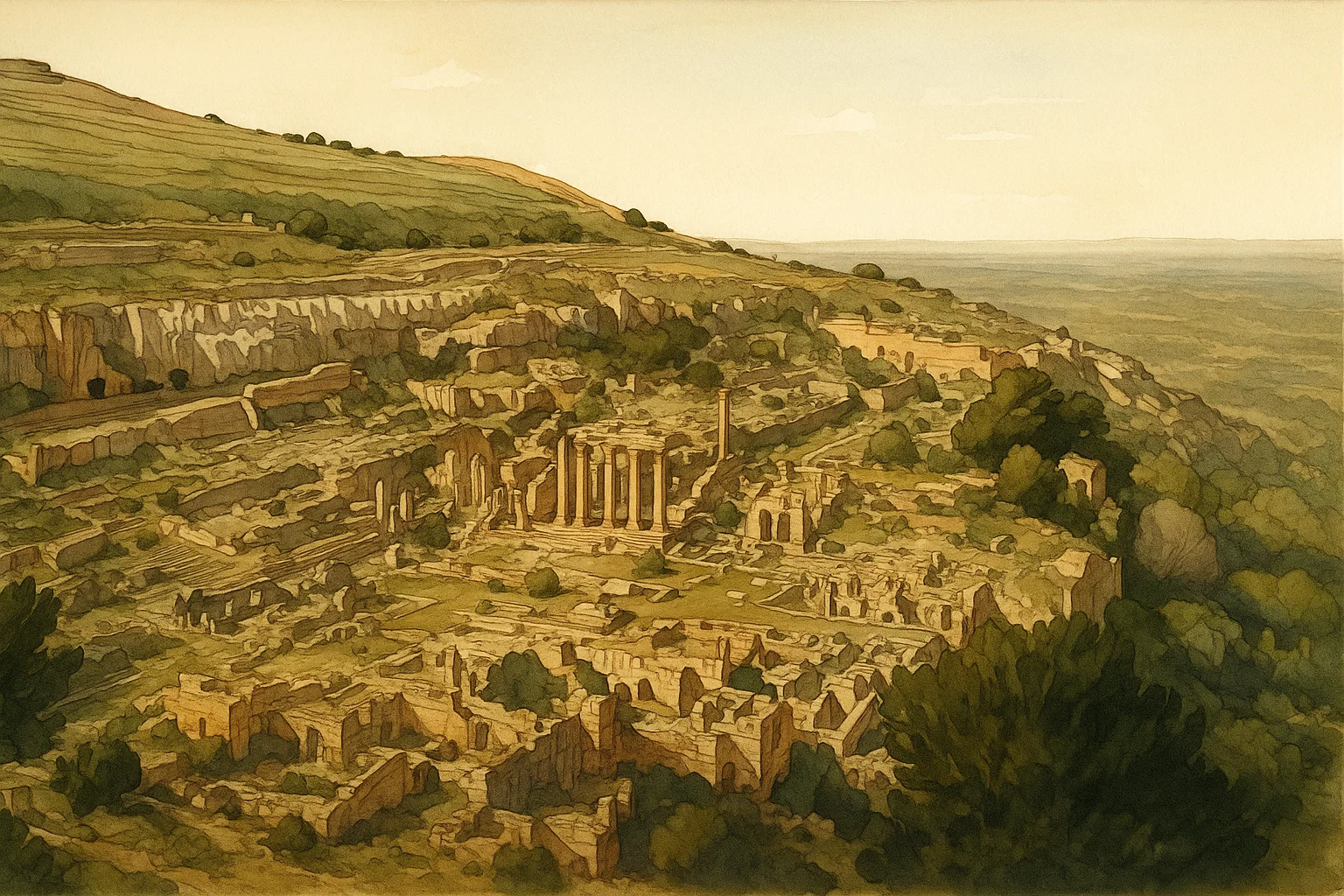
When we conjure images of the ancient world, our minds turn to familiar pillars of history: the democratic forums of Athens, the imperial grandeur of Rome, the monumental pyramids of Egypt. These civilizations form the bedrock of our popular understanding of antiquity. Yet, standing beside them in influence and brilliance was another city, a cultural and intellectual powerhouse that has been almost completely erased from the collective memory. This is the story of Cyrene.
Listen to the brief from NotebookLM by Google
Introduction: The City That History Forgot
For centuries, Cyrene was a superpower of culture and trade, a Greek colony older than Alexandria, and a crossroads where African, Greek, Jewish, and Roman worlds met. It produced philosophers like Aristippus, founder of his own school of thought; Callimachus, one of antiquity’s greatest poets; and Synesius, a philosopher-bishop who shaped early Christian thought. It was even the home of Simon of Cyrene, the man said to have carried the cross of Jesus. So why was this brilliant city—a beacon of philosophy, trade, and art—effectively erased from popular history? The reasons are a surprising mix of modern politics, narrative branding, and a history too complex for any single culture to claim.
1. It’s Buried by Modern Politics, Not Sand
The most immediate reason for Cyrene’s obscurity is its location. The ancient city sits in modern-day Libya, a region marked by political instability, militia control, and severely restricted access. Unlike Egypt, which has built a stable and profitable global industry around its archaeological treasures, Libya lacks the security and infrastructure needed for large-scale excavation, preservation, and tourism. The area surrounding Cyrene has been a center of political tension, plagued by looting and the smuggling of priceless artifacts into private collections.
This contemporary reality makes the city a taboo subject for many museums and academics. History, in this case, has become a casualty of modern conflict. The past is silenced not by its lack of importance, but by the dangers of the present.
Archaeologists avoid Cyrene for the same reason they avoid Syria and Yemen — not because it isn’t important, but because it is dangerous.
2. It Threatens the “Ancient Egypt” Brand
In the global marketplace of history, Egypt has masterfully cultivated a powerful and instantly recognizable brand: “Pharaohs, Pyramids, Cleopatra.” This narrative has become so dominant that it has created a monopoly on the story of ancient North Africa, leaving the equally significant histories of Libya, Tunisia, and Morocco in its shadow.
Cyrene directly threatens this monopoly. As a Greek, Roman, and Jewish powerhouse in North Africa, its story complicates the simplified, Egypt-centric version of the region’s antiquity. By presenting a different, yet equally compelling, center of ancient life, Cyrene challenges the brand that Cairo has so carefully controlled. This reveals a stark reality: in the 21st century, the survival of an ancient city’s story depends less on its historical significance and more on its “marketability.” History has become a battle of brands, and Cyrene, with its complex, multinational identity, was left without a marketing department.
3. It Valued Philosophers Over Pharaohs
Our modern fascination with antiquity is often driven by a desire for visual spectacle. We travel to see colossal statues, towering temples, and monumental tombs. Cyrene, however, offers a different kind of legacy. It was an intellectual capital, a city that produced ideas rather than giant stone structures. Its greatest exports were influential thinkers like Aristippus, founder of the Cyrenaic school of philosophy; the great poet Callimachus; and the philosopher-bishop Synesius, whose work bridged the classical and Christian worlds.
This focus on the philosophical over the monumental makes Cyrene a poor fit for the modern tourist fantasy. Its legacy is less tangible but no less powerful than Egypt’s, yet it struggles to compete for attention in a world that prefers grand architecture to grand ideas.
Tourism prefers big rocks over big philosophers.
We have become consumers of history, not students of it. Our cultural tourism is geared toward the Instagrammable ruin, not the invisible but world-altering idea. Cyrene is a casualty of this modern intellectual diet, which prizes the monumental over the mental.
4. Its Greatest Treasure is a Scientific Mystery
For centuries, Cyrene’s economy was driven by a resource found nowhere else on earth: the silphium plant. Once worth its weight in gold, silphium was hailed as a universal medicine and, most notably, an effective contraceptive. The plant was so vital to the city that it was stamped on its coins, but it was harvested to extinction by the 1st century CE.
This story is deeply inconvenient for modern historians. It suggests that ancient medicine was far more advanced than commonly believed and that effective fertility control existed long before the modern era. Furthermore, it points to a unique biological resource that ancient people utilized and exhausted, which modern science can neither identify nor replicate. Cyrene’s history becomes inconvenient because it challenges our core assumptions about the technological and scientific limitations of the ancient world.
5. It Was a “Portal Culture” No One Could Own
Perhaps the most profound reason for Cyrene’s obscurity is its very identity. It was not a homogenous city but a hybrid one—a “portal culture” where Greek, Roman, Jewish, Egyptian, and indigenous Berber civilizations met, mixed, and thrived. Cyrene was a true crossroads of the ancient world.
This complex identity was a problem from the moment European archaeologists began excavating the region. In Egypt, they found a neat, comprehensible timeline that produced simple, sensational stories for newspapers back home and reinforced imperial narratives. In Cyrene, they found a messy, overlapping mix of cultures that defied easy packaging. It couldn’t be used as simple propaganda.
This historical problem extends to the present day. No single modern nation can lay exclusive claim to Cyrene’s story. Egypt cannot claim it, nor can Greece, Israel, or Italy. Because its narrative belongs to everyone, it has effectively been claimed by no one. It is easier for each culture to focus on the histories they can “own” and, in doing so, to collectively ignore the brilliant hybrid city they all shared.
When no one can own the narrative, the narrative gets buried.
Conclusion: What Else Are We Missing?
Cyrene’s disappearance from the popular stage of history was not due to a lack of importance. On the contrary, it was a city of immense significance. Its story was buried by a potent combination of modern political danger, powerful narrative branding, our preference for spectacle over ideas, and an identity too inconveniently complex for colonial or modern nations to categorize.
The story of Cyrene serves as a powerful reminder that the history we know is not the whole story. It is a curated version, shaped by present-day forces as much as by past events. If a city this brilliant can be forgotten, what other inconvenient histories and buried truths are waiting to be rediscovered?