(The writer of this site tests AI products while doing comparative research on history. The analysis of the portrait is provided by ChatGPT and then narrated by NotebookLM. The infographic is also from NotebookLM. Did ChatGPT or NotebookLM notice something new about about the painting of Louis the Pious?)
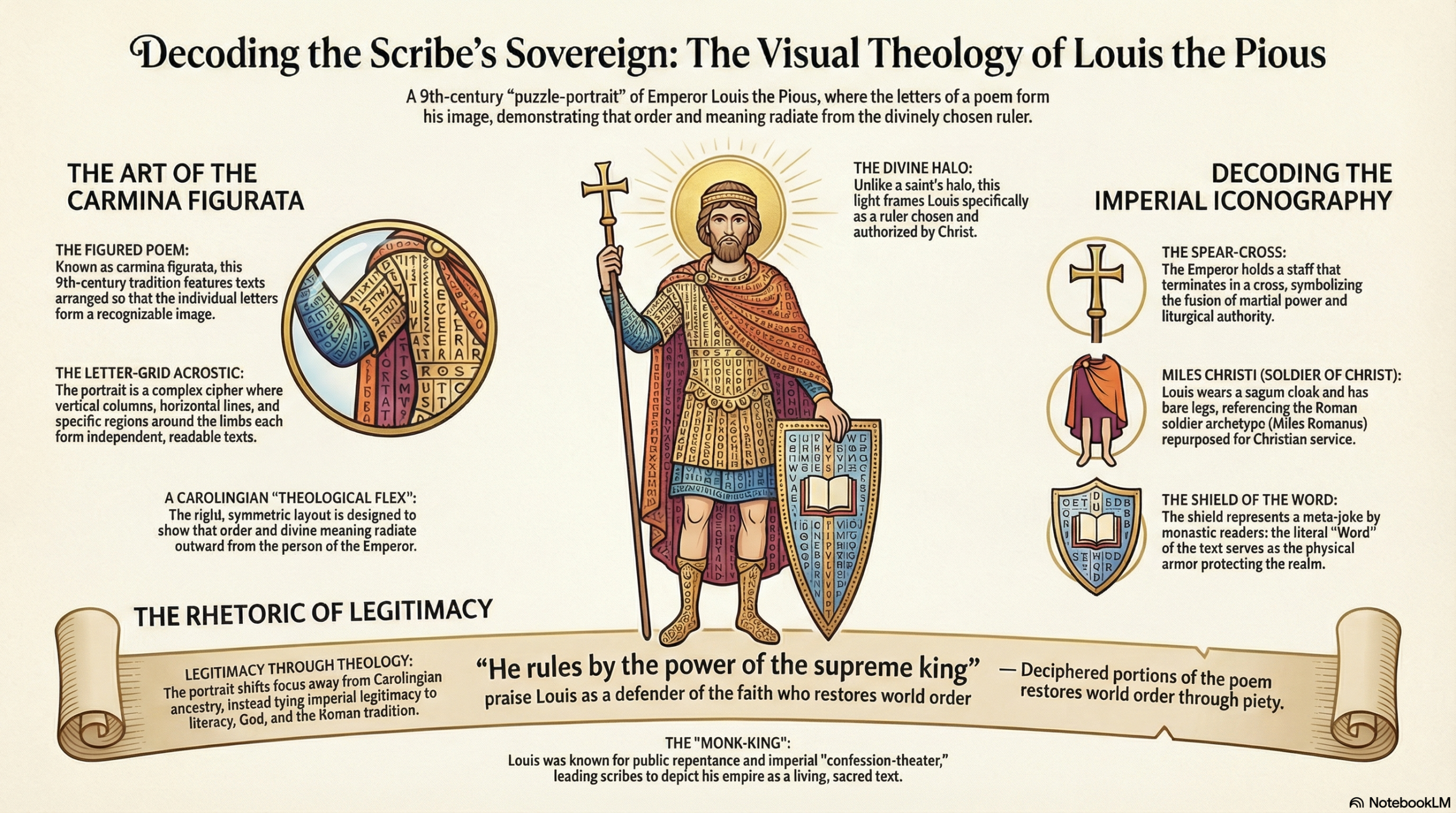
The provided sources examine a unique ninth-century carmina figurata, which is a visual poem where the arrangement of Latin letters creates a portrait of Emperor Louis the Pious. This intricate artwork functions as early medieval propaganda, depicting the sovereign as a soldier of Christ whose legitimacy is derived from divine authority and religious devotion. The image skillfully blends martial and liturgical symbols, such as a shield and a spear-cross, to portray the ruler as a protector of the faith and a restorer of worldly order. Beyond its aesthetic value, the letter-grid acrostic reflects a Carolingian obsession with symmetry and literacy, suggesting that the empire itself is a structured text governed by God. Ultimately, the portrait serves to reinforce the concept of the monk-king, a leader whose right to rule is defined by his piety and theological alignment rather than mere conquest or lineage.
The 1,200-Year-Old Portrait That’s Actually a Secret Poem
Introduction: More Than Just a Portrait
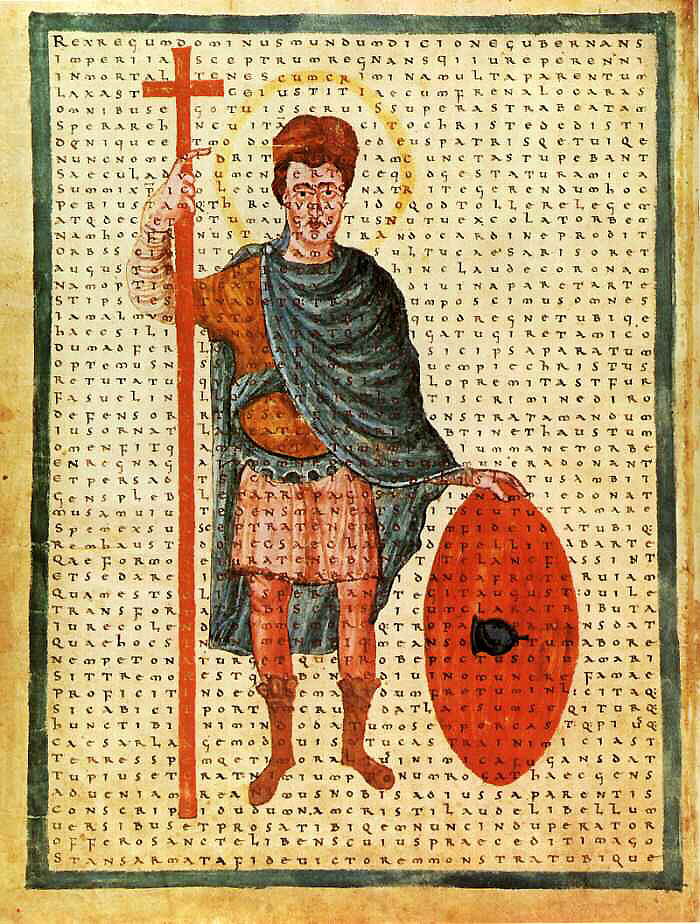
At first glance, this image of the emperor Louis the Pious looks like a fairly typical piece of early medieval art. Hailing from the 9th-century “Harley Psalter / Utrecht School style” tradition, it shows a ruler in military attire, holding a shield and a cross-topped spear. But this is no ordinary portrait. This 1,200-year-old image is a dense matrix of code, where theology is rendered as cryptography—a political statement and a theological argument all coded in plain sight.
This article will unpack the most surprising secrets hidden within this “puzzle-portrait,” revealing a masterpiece of visual propaganda where every detail—down to the very letters that form the image—carries a profound message.
1. The Entire Portrait is a Secret Poem
The most astonishing feature of this portrait is that the grid of letters surrounding Louis is not random filler. The image is a carmen figuratum, a “shaped poem,” where the text is arranged so that the letters themselves form an image. The letters create a continuous Latin praise poem dedicated to the emperor.
The complexity is staggering. This isn’t just a block of text; it’s a sophisticated “cipher-layout trick.” The vertical column of letters forms an independent text, the horizontal lines form another, and regions around the limbs contain secondary acrostics. This wasn’t just writing; it was an act of architectural composition, requiring a level of pre-planning that is difficult to comprehend. This layout deliberately demonstrates that order, symmetry, and meaning radiate outward from the emperor—a powerful “Carolingian theological flex.”
2. It’s a Radical Argument for a New Kind of Power
In the early 800s, the Carolingian world was grappling with a fundamental political question: What makes a king legitimate—blood, conquest, or God? This image provides a clear and revolutionary answer: “God + literacy + theology.”
This represented a subtle but revolutionary shift from established Carolingian precedent. The poem, a mixture of panegyric and imperial theology, ties Louis’s legitimacy directly to Christ, strategically connecting him to Constantine as an heir to a specifically Christian kingship. This argument was no abstract theory; it was a direct reflection of Louis’s unique personal reign. Known as the “monk-king,” he performed public repentance and staged what amounted to imperial confession-theater. The portrait’s emphasis on piety was a tribute to his highly unusual style of rule. A translated excerpt from the poem highlights this core message:
“He rules by the power of the supreme king, the defender of the faith, who conquers through piety, and restores the order of the world.”
3. Every Object is a Symbol Fusing God and Government
Beyond the text, let’s decode the key symbols, each of which is a masterclass in theological and political fusion.
* The Halo: This doesn’t frame Louis as a saint in the traditional sense. Instead, it designates him as a ruler specifically chosen by Christ, his power divinely sanctioned.
* The Spear-Cross: This brilliant object fuses two distinct sources of authority. The spear represents his martial power as a warrior and protector of the realm, while the cross represents his liturgical authority as the defender of the Christian faith.
* The Roman Uniform: The bare legs and sagum cloak are meant to evoke the classical Roman soldier archetype. This visual reference transforms him from a Miles Romanus (Roman Soldier) into a Miles Christi (Soldier of Christ), a warrior fighting for a divine, not just a worldly, empire.
The monastic scribes who created this work also embedded a clever joke that their educated audience would have understood. By constructing the emperor from the very letters of a holy poem, the scribes offer a brilliant visual metaphor: the Word of God literally forms the armor that shields the realm.
Conclusion: An Empire Made of Text
This portrait of Louis the Pious is a masterful piece of visual propaganda where the medium is the message. It is far more than a likeness; it is a complex theological document that argues for a new model of Christian kingship. In a fitting tribute to their “monk-king,” the scribes crafted an image where the empire becomes a sacred text, its order and meaning guaranteed not by armies, but by the Word of God.
What kinds of complex visual messages might be shaping our own views of leadership today?
Louis The Pious, also called the Fair and the Debonaire, was King of the Franks and co-emperor with his father, Charlemagne, from 813, was born on January 1, 0778.
Louis The Pious
was conceived around March 27, 0777
and has 1 event
A full gestation takes 280 days. Have you ever checked what happened when you were conceived? You should, because it matters.
269 days before
(about 9 months)

King Charlemagne spends Easter in Nijmegen, and leads a large Frankish army to Paderborn, where a general assembly of Carolingian and Saxon leaders had been summoned
It happened on April 7, 0777
Featuring: Charlemagne.
Xanadu Registrant
These are the notable people who registered Louis The Pious into the Xanadu blockchain, after making a gift to humanity.
At this time, I do not have a female DNA contributor. To find this person, you must look at the events that occured around March 27, 0777.
Louis The Pious
January 1, 0778
also called the Fair and the Debonaire, was King of the Franks and co-emperor with his father, Charlemagne, from 813
Charlemagne
0748-0814
first recognised emperor to rule from the west after the fall of the Western Roman Empire approximately three centuries earlier
If you are doing research on Louis The Pious and would like to seethis profile expanded, join the patreon and make a request!